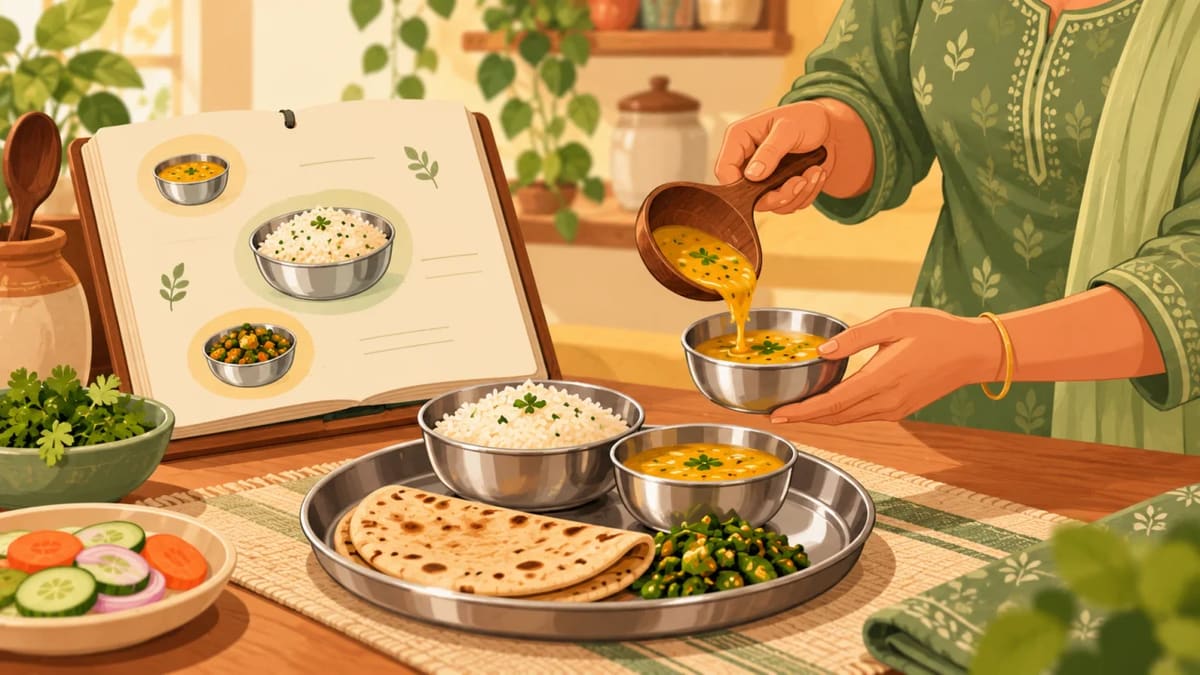
For many Indian meals, a katori, roti or ladle is a more natural way to describe a serving than grams. These household measures can help a nutritionist and client talk about food in terms the client recognises, but they are not fixed units. A katori varies by household, a roti varies in size, and the recipe matters. When a diary turns those descriptions into calories or macros, the result is an estimate to discuss, not a precise measurement of the meal.
Begin with the client's everyday measure
Ask how the client usually describes a serving at home. They might say one katori of dal, two roti, a plate of poha, or a glass of chaas. Begin with that language rather than requiring the client to convert a familiar meal into grams. The first job is to understand what they mean.
One katori can be small, deep, wide or filled to different levels. A roti may be thin or thick, small or large. A ladle may vary, and the client may take more than one. These are not reasons to discard household measures; they are reasons to ask what the measure refers to and keep uncertainty visible.
Helpful questions include “Is that your usual katori?” and “Was it filled to the top?” Ask one question at a time. The client may not know an exact volume, and that is fine. A description such as “the small steel bowl we use at home, filled about halfway” can add context without pretending to be a laboratory measure.
Separate amount served from amount eaten
Households often serve food communally. A bowl of dal in the centre of the table is not the same as one person's portion. Ask whether the client is describing what was served, what they put on their plate, or what they remember eating. Those distinctions matter when discussing an entry.
The meal can also include refills. A client may initially remember one katori of rice and later recall taking more. Invite correction: “Did you have another serving, or was the first amount about right?” Avoid phrasing that signals which answer you expect.
If food remained, ask only when the detail is relevant and the client remembers it. A clean plate does not prove that every meal was the same size, and leftovers do not indicate why the portion differed. The client’s account provides context that the dish name alone cannot supply.
Build the description one component at a time
Mixed meals are easier to discuss when separated into familiar components. “Rajma chawal” names the combination; “one serving of rajma with about one plate of rice” adds a rough portion description. For a meal with roti, dal and sabzi, ask about each part only as needed. Do not make every entry a long interview.
| Client's phrase | A useful clarification |
|---|---|
| “One katori dal” | Which bowl do you mean, and about how full was it? |
| “Two roti” | Were these your usual home size, and did you have another? |
| “One plate poha” | Was it a small bowl, a regular plate, or a larger serving? |
| “Rajma chawal” | Do you remember the rice and rajma portions separately? |
| “A little sabzi” | Would you describe it as a spoonful, a small bowl or another amount? |
Use the client's answer rather than converting every phrase to a standard value without explanation. If they do not remember, note the ambiguity. The record should show what the person reported and what remains uncertain.
Recipes change what a portion represents
The same dish name can refer to different ingredients and preparation. Dal may be thin or thick; tadka may include different amounts of oil or ghee. Poha can include peanuts, vegetables or other additions. A sabzi's recipe and cooking method vary by household. The client may not know how it was made, especially when someone else cooked.
Ask whether the client knows the preparation and whether they want to add that context. Do not assume they should know every ingredient. If recipe details are unavailable, keep them unknown. A generic entry may still support a conversation about the meal, but any nutrition values based on it need to be labelled as estimates.
Calories and macronutrients are not measured simply because a diary displays a number. The estimate depends on the food description, assumed portion and recipe information. A katori converted to a standard database serving may differ from the client's bowl. A value can be useful for a broad discussion while remaining uncertain for that individual serving.
Introduce numbers with honest language
If you discuss a nutrition estimate, explain how it was formed in plain terms: “This is an estimate based on the dish and portion we recorded. Your bowl or recipe may differ.” Avoid implying that a value is exact or directly confirmed by an external reference. IFCT 2017 by ICMR-NIN is a named food-composition reference, but it does not measure a client's particular home-cooked meal.
Do not display more digits than the input supports. A precise-looking number can suggest that the portion was weighed and the recipe known. If the client gave a range, preserve it or choose an approximate value only with clear language and a reason. If there is not enough detail for a useful estimate, focus on the description instead.
It can help to explain the difference between a reference food and the client's dish. A database may describe a defined food item under particular conditions. The client's dal may contain a different recipe, water content and serving. The reference is context for an estimate; it is not proof of the exact calories or macros in the meal.
Make measurement optional and purposeful
There are situations where weighing ingredients or using a known vessel can add useful information. Discuss why the extra detail matters before asking a client to measure. If the client cooks the dish and is comfortable measuring ingredients, that may clarify a recipe. If they eat at a canteen or share family food, weighing may be unrealistic.
Avoid making scales a default condition of a successful diary. The method should work in the person's real setting. A household description may be the most practical option for a meal eaten outside the home. You can still ask for a smaller or larger comparison, or what the client usually serves themselves.
If a client wants to compare servings over time, use a consistent household vessel where possible and explain that consistency can help discussion without creating an exact gram value. The goal is to make the record more interpretable, not to turn every meal into a measurement exercise.
A client-led example
Dr Meera Iyer reviews Priya S.'s note: “2 roti, one katori dal, sabzi.” Meera asks whether the roti and bowl are typical for Priya's home and whether the note describes what was served or eaten. Priya says the bowl was a small steel katori, nearly full, and she is unsure how much oil was in the sabzi. Meera keeps that detail open and asks whether Priya wants to discuss the meal or use the same description next time.
The entry is now more informative without pretending to know exact weights. If a nutrition estimate is shown, both can understand that it uses an approximate household portion and incomplete recipe details. That is a more honest foundation than a precise-looking value detached from the meal's context.
How Shellel helps
Shellel gives nutritionists a diary to review meal descriptions with clients in familiar language. Household measures can support that conversation, while any nutrition values remain estimates that depend on portion and recipe details. Explore the nutritionist workflow at /nutritionists. For a related discussion of logging portions, read how to get honest portion descriptions.
Quick answers
Asked and answered
Can a katori be converted to grams?
Only if you know the vessel, food and fill level well enough for the conversion to mean something. Katoris and foods vary, so a conversion should be treated as an approximation and explained.
Are calories and macros from a household measure exact?
No. They depend on the portion and recipe assumptions. Describe them as estimates and avoid implying that the client's meal was directly measured.
Should I ask clients to weigh roti and rice?
Only when the purpose is clear and the client can reasonably do it. Familiar measures can be more workable for an everyday conversation.




