AI-assisted. Edited by Aman Singh, Founder.
An ICMR-NIN dietary guidelines summary should help a dietitian move from population guidance to a practical conversation. It should retain the edition, the relevant life stage and the distinction between a reference food pattern and an individual clinical plan.
Start with the current official document
Use ICMR-NIN’s Dietary Guidelines for Indians 2024 and its 2024 PDF. Check the title page: a working official URL can still serve an older edition. Keep the edition and page reference in the practice’s own notes when quoting a quantitative target.
The broad priorities include dietary variety and attention to food groups, added sugar, salt and fats. Life-stage needs and food safety also need their own context. A population illustration does not establish a personalised energy target or a disease-specific allowance.
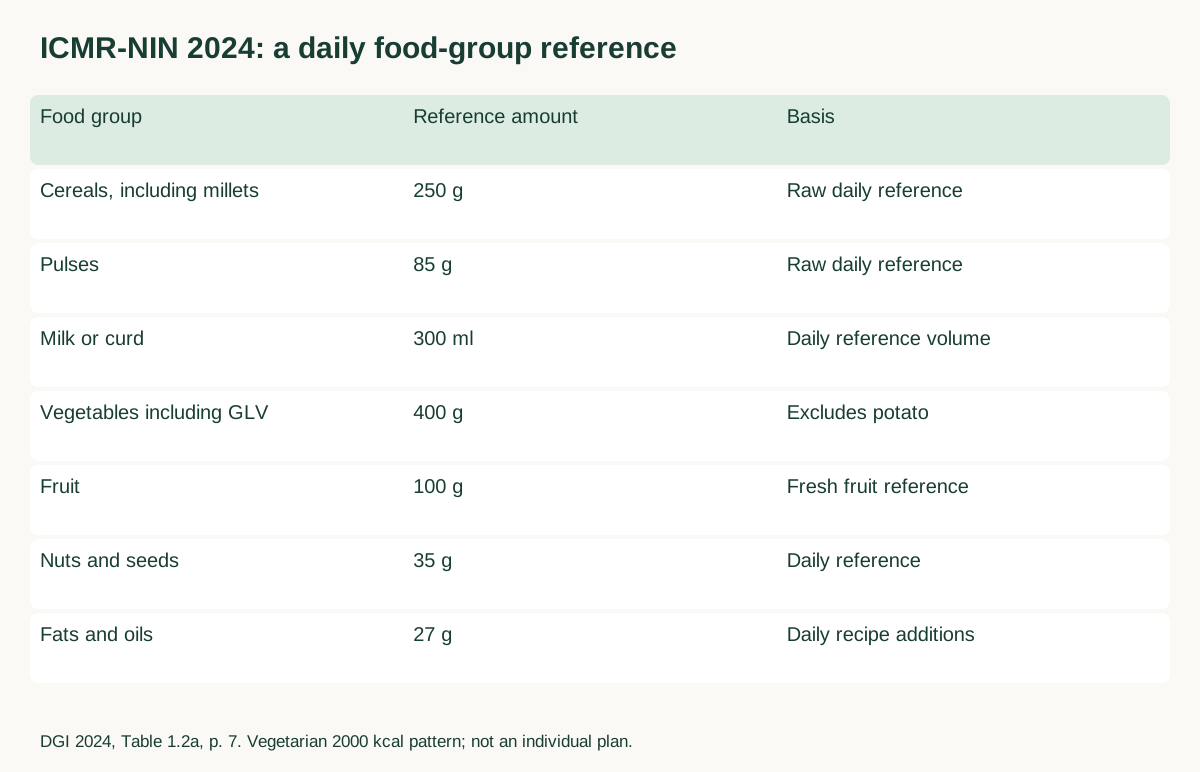
A 2,000 kcal vegetarian reference
| Food group | Reference amount | Basis |
|---|---|---|
| Cereals, including millets | 250 g | Raw daily reference |
| Pulses | 85 g | Raw daily reference |
| Milk or curd | 300 ml | Daily reference volume |
| Vegetables including GLV | 400 g | Excludes potato |
| Fruit | 100 g | Fresh fruit reference |
| Nuts and seeds | 35 g | Daily reference |
| Fats and oils | 27 g | Daily recipe additions |
The figures come from DGI 2024, Table 1.2a, printed page 7. This is a daily reference pattern: it does not say that every client needs 2,000 kcal or that these are cooked serving weights. The graphic is an original table, not an official NIN plate. Ask what is feasible and adapt the plan after assessment.
Keep a plate model separate from its calculation
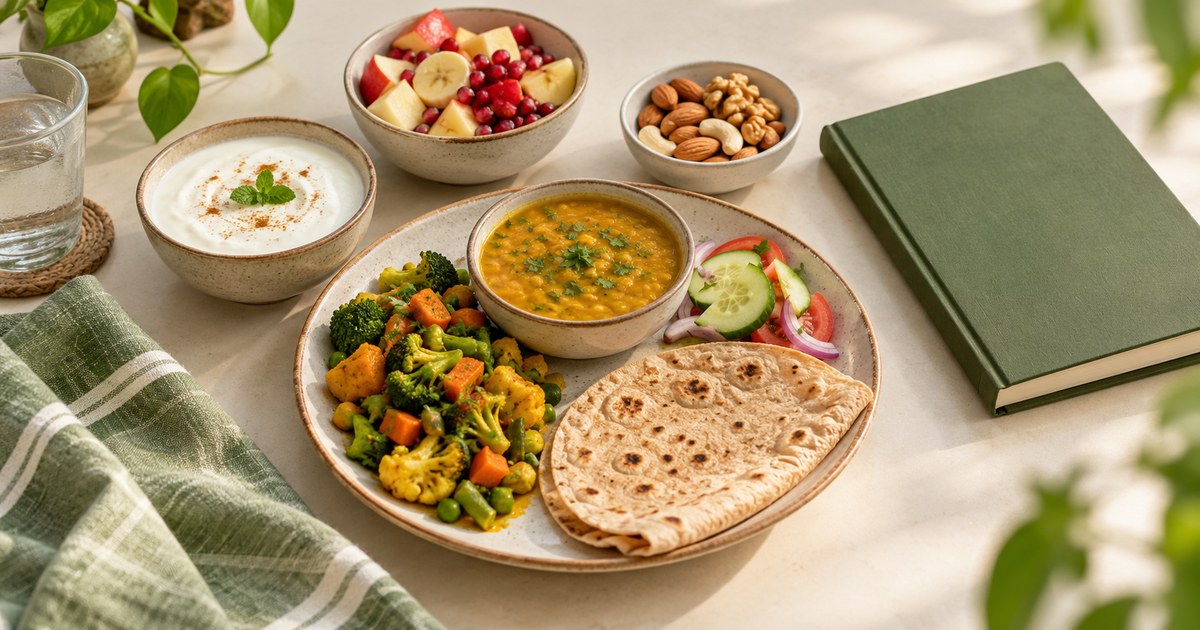
A food-group illustration is useful for discussing variety. Quantitative food targets require the exact reference pattern, energy level and population group. State whether weights are raw ingredients or cooked food, then account for yield before translating them into katori or roti measures. Do not turn a daily raw cereal quantity into the same number of grams of cooked rice.
Use the exchange worksheet to document portion assumptions. The diet chart maker organises a plan; it does not decide which clinical prescription is appropriate. The food database guide explains the limits of food-record estimates.
EAR, RDA and a personalised plan
Use ICMR-NIN’s 2020 brief note on nutrient requirements when distinguishing EAR and RDA. The terms describe different reference concepts; neither should be pasted into an individual’s plan without the applicable assessment.
Bring the reference into a client diary
Use the Indian food database guide for dietitians to understand the record behind an estimate. When the practical task is a plan, try the diet chart maker. For shared diary review, see how a practice gets started. Keep your clinical assessment and the client’s own account alongside any database match.
Quick answers
Asked and answered
Can the reference plate be given unchanged to every client?
No. Select the relevant population guidance, check the individual context and document how the plan was adapted. A graphic alone does not provide the clinical assessment.
What should the dietitian record when using a portion target?
Record the edition, relevant table or page, reference group, raw or cooked basis and the household-measure conversion. Keep the client’s actual preparation and preferences visible in follow-up.