AI-assisted. Edited by Aman Singh, Founder.
An Indian food exchange list is useful only when the practice defines what an exchange means. A familiar katori makes a conversation easier; it does not make rice, dal and curd nutritionally interchangeable. Begin with the clinical purpose of the list, then state the nutrient basis and portion weight.
Name the exchange system before naming the food
For carbohydrate choices, the American Diabetes Association explains the convention of about 15 g carbohydrate per choice. That convention is not a full mixed-food exchange system. A pulse portion contributes protein and carbohydrate; a milk portion also depends on fat content. Do not call a household bowl one universal exchange.
Keep separate columns for food group, weighed portion, carbohydrate, protein, fat and the source. Define whether carbohydrate means total or available carbohydrate; do not silently switch between a label and a composition table.
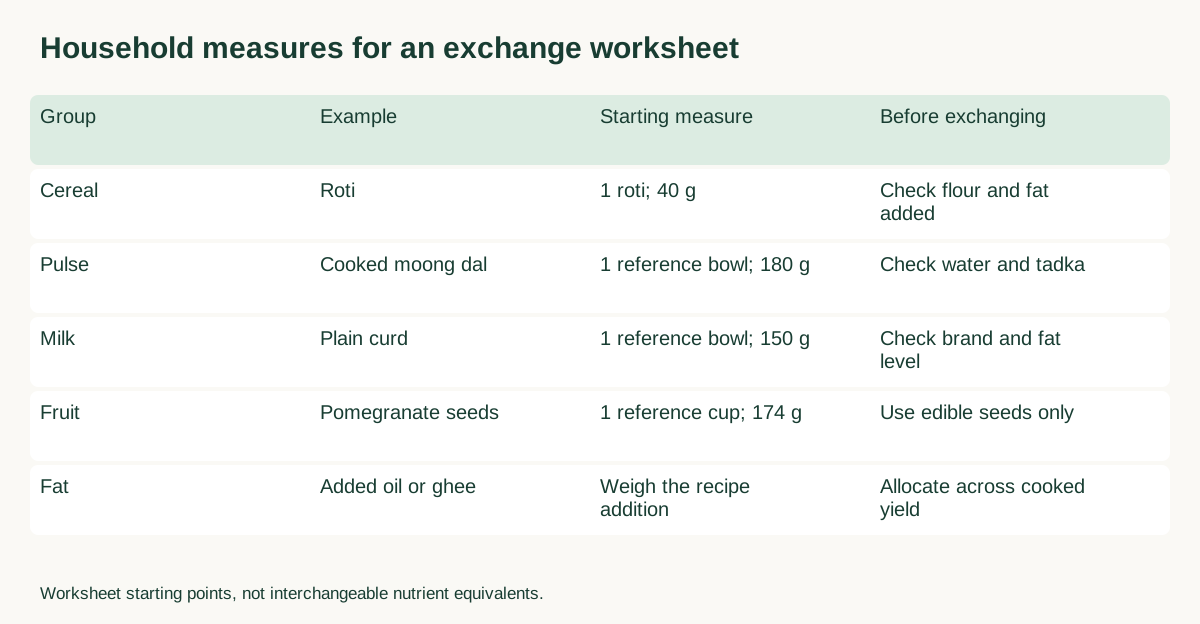
A household-measure worksheet
| Group | Example | Starting measure | Before exchanging |
|---|---|---|---|
| Cereal | Roti | 1 roti; 40 g | Check flour and fat added |
| Pulse | Cooked moong dal | 1 reference bowl; 180 g | Check water and tadka |
| Milk | Plain curd | 1 reference bowl; 150 g | Check brand and fat level |
| Fruit | Pomegranate seeds | 1 reference cup; 174 g | Use edible seeds only |
| Fat | Added oil or ghee | Weigh the recipe addition | Allocate across cooked yield |
The weights above are Shellel reference portions observed on 26 October 2026. They are starting points for checking a diary, not prescribed portions. See roti, idli and makki ki roti separately; their ingredients and database portions differ.
Show the arithmetic without hiding the assumptions
The stored wheat-roti record has 14.2 g carbohydrate for its 40 g reference piece. On a 15 g carbohydrate-choice basis, that is approximately 0.9 choices, rounded only for discussion. This is an arithmetic illustration from the database record, not a laboratory measurement of a client’s roti.
For any verified recipe, divide the carbohydrate in the eaten portion by the exchange basis your practice uses. If a recipe has not been checked, leave the exchange entry pending instead of presenting a guessed bowl as exact. Keep the unrounded calculation in the worksheet and decide rounding consistently with the dietitian.
Use the list in a consult
Ask the client to identify the usual bowl once, ideally alongside a measured example. Record whether the bowl was level, heaped or shared. Ask about oil and accompaniments separately, then use the same measure during follow-up. A changed recipe or larger katori needs a revised estimate.
Use ICMR-NIN’s IFCT information to choose appropriate ingredient references; do not attribute every cooked database dish to IFCT. Keep practical portion checks with the calorie reference for roti, idli and dosa and the carbohydrate-counting workflow.
Bring the reference into a client diary
Use the Indian food database guide for dietitians to understand the record behind an estimate. When the practical task is a plan, try the diet chart maker. For shared diary review, see how a practice gets started. Keep your clinical assessment and the client’s own account alongside any database match.
Quick answers
Asked and answered
Can one katori always count as one exchange?
No. The food, recipe, bowl capacity and defined exchange basis all matter. Calibrate the household measure and retain the weighed reference.
Are milk, fruit and cereal exchanges interchangeable?
Only within the defined system and clinical plan. Matching carbohydrate alone does not match protein, fat, fibre or the rest of the meal.