AI-assisted. Edited by Aman Singh, Founder.
A wedding-season diet plan for clients should account for the week people actually have: travel, sangeet, late dinners, shaadi buffets and visits with family. For a dietitian, the useful starting point is a shared check-in plan rather than a list of rules for every event.
Map the celebrations before setting the diary
Ask which events matter, where the person will stay, who will prepare meals and what ordinary routines may change. Find out what support they want. A client may want help keeping records during travel, discussing a buffet meal or returning to their usual schedule after several celebrations.
Agree routine response hours and the next contact. For someone with a condition affected by meal timing, travel or fasting, keep the existing clinical plan explicit and coordinate unresolved questions with the treating team. Do not issue a generic festive calorie or medication adjustment.
A check-in plan the practice can adapt
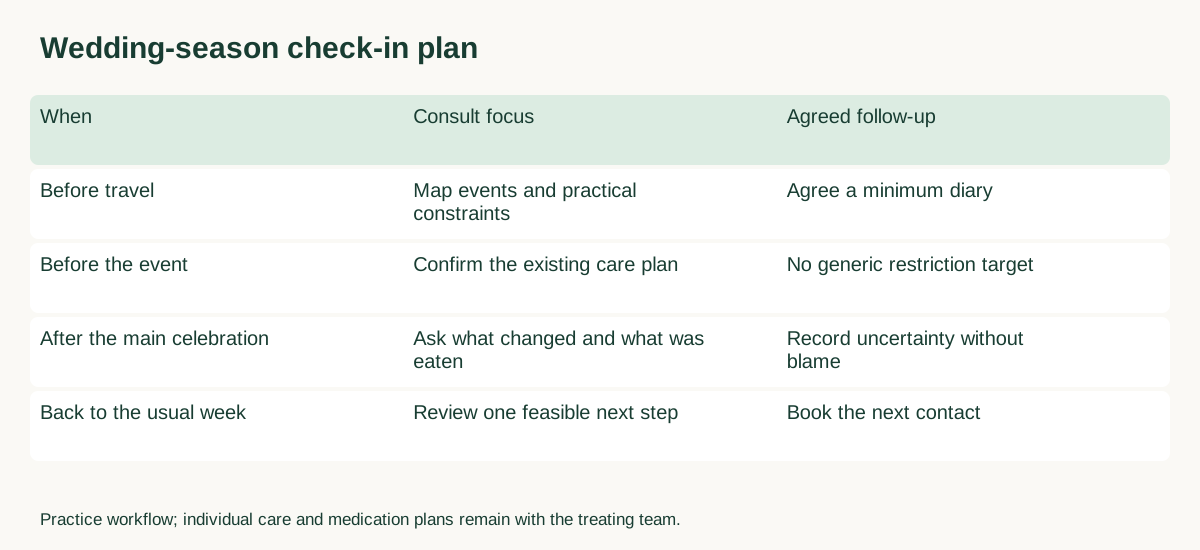
| When | Consult focus | Agreed follow-up |
|---|---|---|
| Before travel | Map events and practical constraints | Agree a minimum diary |
| Before the event | Confirm the existing care plan | No generic restriction target |
| After the main celebration | Ask what changed and what was eaten | Record uncertainty without blame |
| Back to the usual week | Review one feasible next step | Book the next contact |
This follows the same practical structure as the Diwali check-in plan, with the client’s own event dates instead of assumed festival dates. The messages are prompts, not a promise of immediate clinical monitoring.
Agree a minimum diary for a busy day
Ask for food, rough amount and context when the person can record them. A buffet entry might identify a plate of chicken biryani, a shared khasta kachori or jalebi, while marking uncertainty about recipe or piece size. Use the sweets per-piece reference to ask a useful follow-up, not to judge the celebration.
If the person cannot record every meal, choose occasions that answer the question you agreed on. Missing entries remain gaps. Do not fill them with an average wedding menu or count a planned meal as an eaten meal.
Three example messages
- Before travel: “Which days will feel different, and what would be useful for us to keep track of?”
- After the main event: “How did the evening go? Add the foods and rough portions you remember, and mark what you are unsure about.”
- Back in the usual week: “What feels easy to return to, and what would you like us to work on next?”
Adapt the wording and timing with the client. Avoid compensatory fasting, a punitive “detox” or a promise to prevent weight change. Discuss the diary in the context of the person’s goals and wider assessment.
Bring the reference into a client diary
Use the Indian food database guide for dietitians to understand the record behind an estimate. When the practical task is a plan, try the diet chart maker. For shared diary review, see how a practice gets started. Keep your clinical assessment and the client’s own account alongside any database match.
Quick answers
Asked and answered
Should clients skip meals before a shaadi buffet?
Do not give a blanket compensatory instruction. Discuss practical meal timing within the individual’s existing care plan and coordinate condition-specific needs with the treating team.
What should the first post-wedding consult cover?
Begin with the client’s account, identify which diary details are known, and agree one useful next step. Separate an uncertain recall from an entry made at the time.