
AI-assisted. Edited by Aman Singh, Founder.
A dietitian client intake form template should help the first conversation, not force every client into the same assessment. Use this blank form to organise history, lab context, food recall and goals. Adapt it to your scope and the information you actually need.
Download the blank template
Download the intake form PDF or download the editable DOCX. Both are blank practice documents. There is no public intake submission or client-data upload on this page.
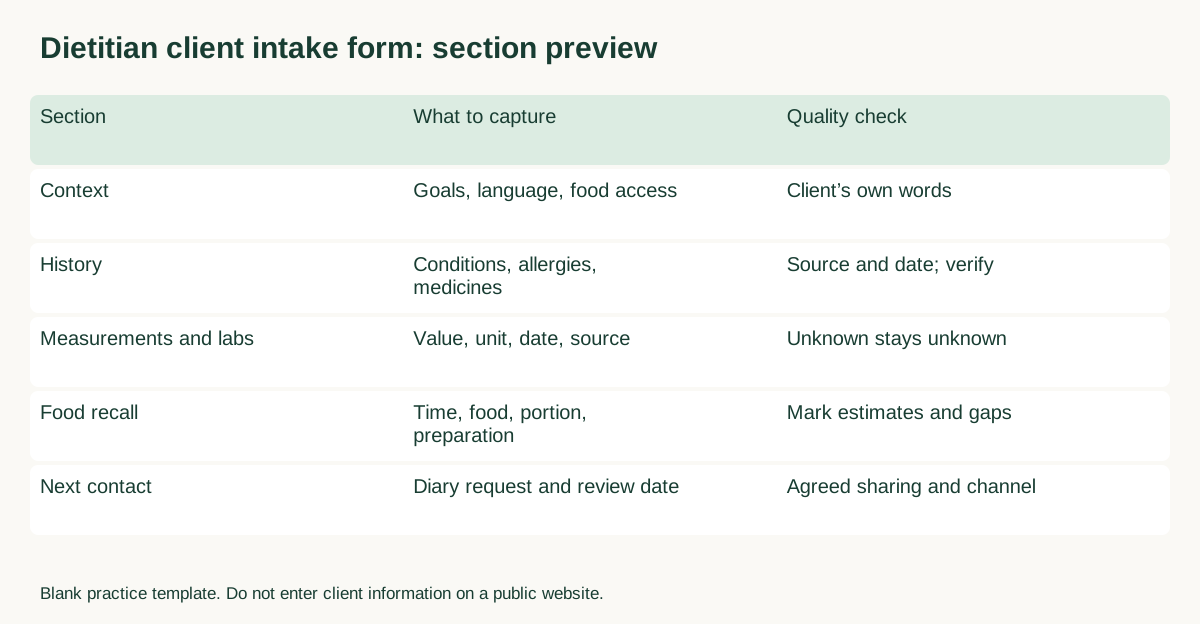
| Section | What to capture | Quality check |
|---|---|---|
| Context | Goals, language, food access | Client’s own words |
| History | Conditions, allergies, medicines | Source and date; verify |
| Measurements and labs | Value, unit, date, source | Unknown stays unknown |
| Food recall | Time, food, portion, preparation | Mark estimates and gaps |
| Next contact | Diary request and review date | Agreed sharing and channel |
Before the client completes it
Explain why each section matters, which questions are optional, who will see the record and how the client can correct it. Use a practice client identifier where that is enough. Do not collect identity documents, passwords or unrelated records just because a template has room for attachments.
Agree a secure return method and a retention process for your practice. If a question is outside your scope or needs a treating clinician’s input, mark it for clarification. A completed form is reported information until appropriately verified; it is not a diagnosis.
Keep dates, units and uncertainty together
For measurements or labs, record the value, unit, date and source. A client-recalled result and a dated report are different kinds of evidence. Mark an unknown value as unknown. Do not carry an old measurement into a current assessment without its date.
In the recall section, use the client’s familiar portions before estimating grams. Record preparation, additions and whether an amount describes served or eaten food. A brief entry that preserves uncertainty is more useful than a complete-looking row filled with guesses.
Move from intake to a diary request
Choose the question the next diary should answer. Agree the recording period, the minimum detail and when you will review it. The intake form records the starting history; the food diary supplies entries over time. Do not copy a one-day recall into every day of a weekly record.
The getting-started guide explains the practice workflow. For tool choices, see free nutrition software, nutritionist software in India and the diet chart maker. Keep the first follow-up focused on what the client agreed to share.
Bring the reference into a client diary
Use the Indian food database guide for dietitians to understand the record behind an estimate. When the practical task is a plan, try the diet chart maker. For shared diary review, see how a practice gets started. Keep your clinical assessment and the client’s own account alongside any database match.
Quick answers
Asked and answered
Does the form replace a clinical assessment?
No. It is a blank record structure that a qualified practitioner can adapt. Interpretation and advice remain with the practitioner and the relevant care team.
Should clients send completed forms through this public page?
No. Download a blank copy, then agree an appropriate private return method with the practice.