AI-assisted. Edited by Aman Singh, Founder.
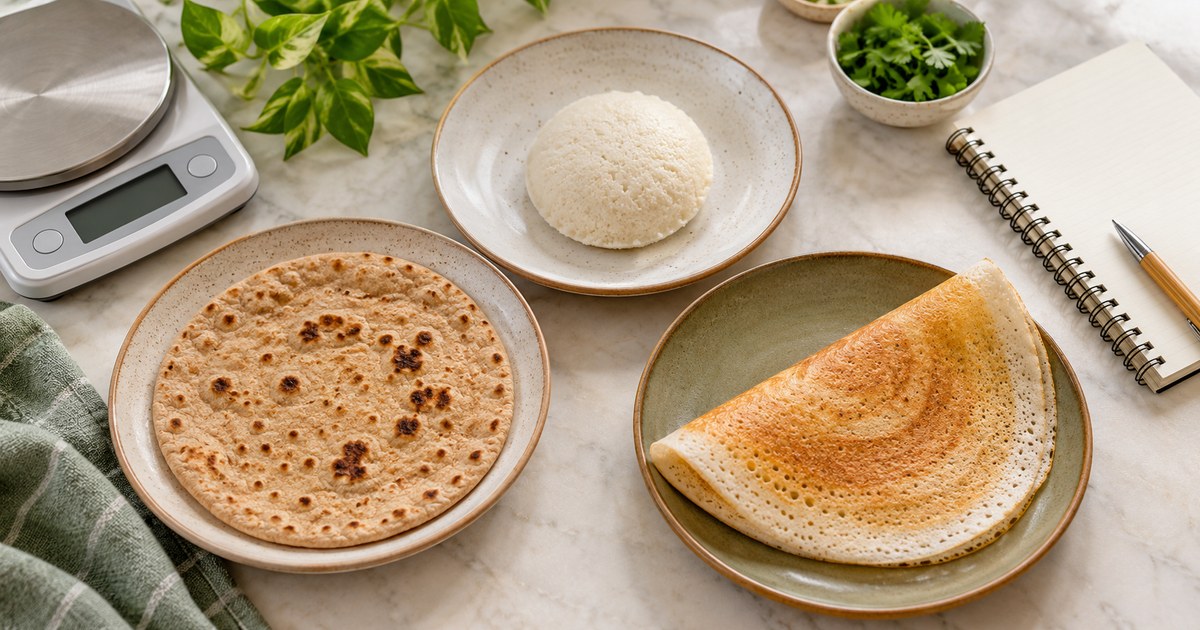
“Two idli” is a useful diary description. It becomes a nutrient estimate only after the practice knows which idli and which size. Keep the piece weight next to calories per roti, idli or dosa, so the printed reference does not turn a household piece into an exact measurement.
The printable reference
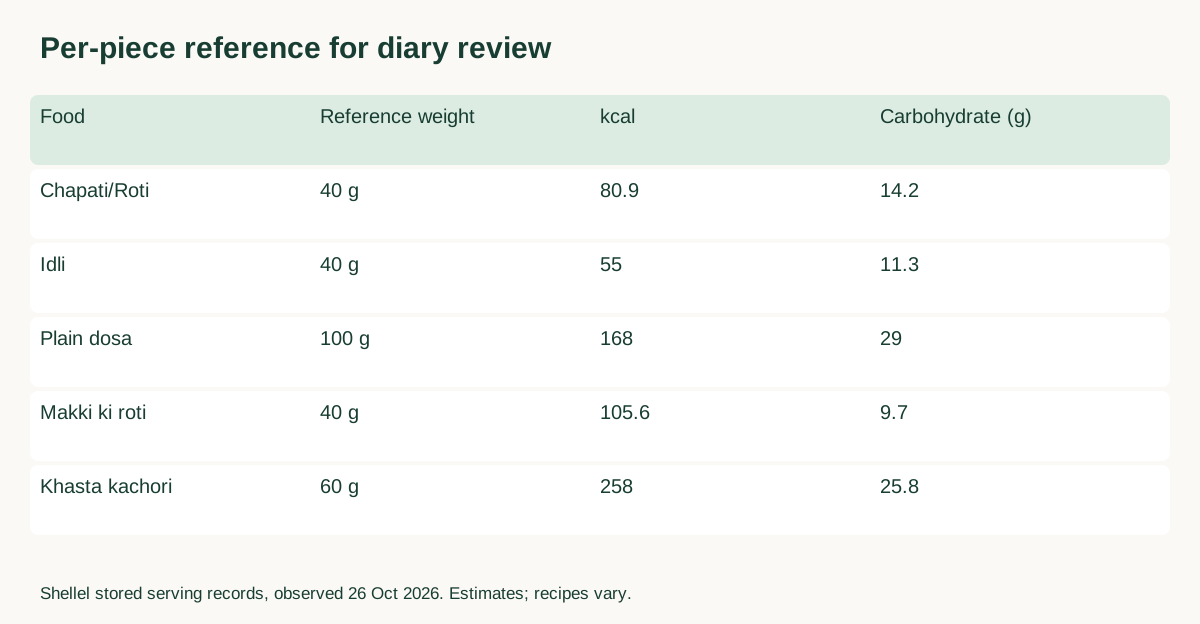
| Food | Reference weight | kcal | Carbohydrate (g) |
|---|---|---|---|
| Chapati/Roti | 40 g | 80.9 | 14.2 |
| Idli | 40 g | 55 | 11.3 |
| Plain dosa | 100 g | 168 | 29 |
| Makki ki roti | 40 g | 105.6 | 9.7 |
| Khasta kachori | 60 g | 258 | 25.8 |
Open the printable portion chart. The rows use Shellel’s stored per-serving values observed on 26 October 2026. They are approximate food-record values, not results of measuring the client’s meal. The wheat-roti record and makki-ki-roti record represent different preparations.
Read one piece before multiplying it
For a matching piece, multiply its reference value by the number eaten. Before doing that, ask whether the diary counts standard idlis, mini idlis, a shared dosa or a larger restaurant roti. If the size differs, use a weighed reference or retain an approximate range rather than a precise-looking total.
The idli page and plain dosa page keep the food context together with the serving. Khasta kachori needs its own record; it is not interchangeable with roti because both are counted as pieces. Check fillings, butter, oil, chutney and sambar separately where relevant.
Make a practice copy that stays useful
Write the date and source on the reference. Keep the food name, reference weight and recipe notes visible when printing. Ask staff to use the same piece convention, then let the client correct an entry when that convention does not fit. A chart is a discussion aid, not a scoring sheet for whether someone ate correctly.
If a client logs a piece count without enough detail, the record can still support a conversation about meal timing or preparation. Do not invent grams simply to populate a calculation. See the household exchange worksheet for separating familiar measures from nutrient equivalents.
Bring the reference into a client diary
Use the Indian food database guide for dietitians to understand the record behind an estimate. When the practical task is a plan, try the diet chart maker. For shared diary review, see how a practice gets started. Keep your clinical assessment and the client’s own account alongside any database match.
Quick answers
Asked and answered
Does every roti weigh 40 g?
No. That is the reference weight of the stored wheat-roti row used here. Home and restaurant pieces differ in size, thickness and added fat.
Can I use this chart as a prescribed meal plan?
No. It is a reference for checking descriptions in a diary. Individual meal planning needs the dietitian’s assessment and an appropriate verified recipe or food record.