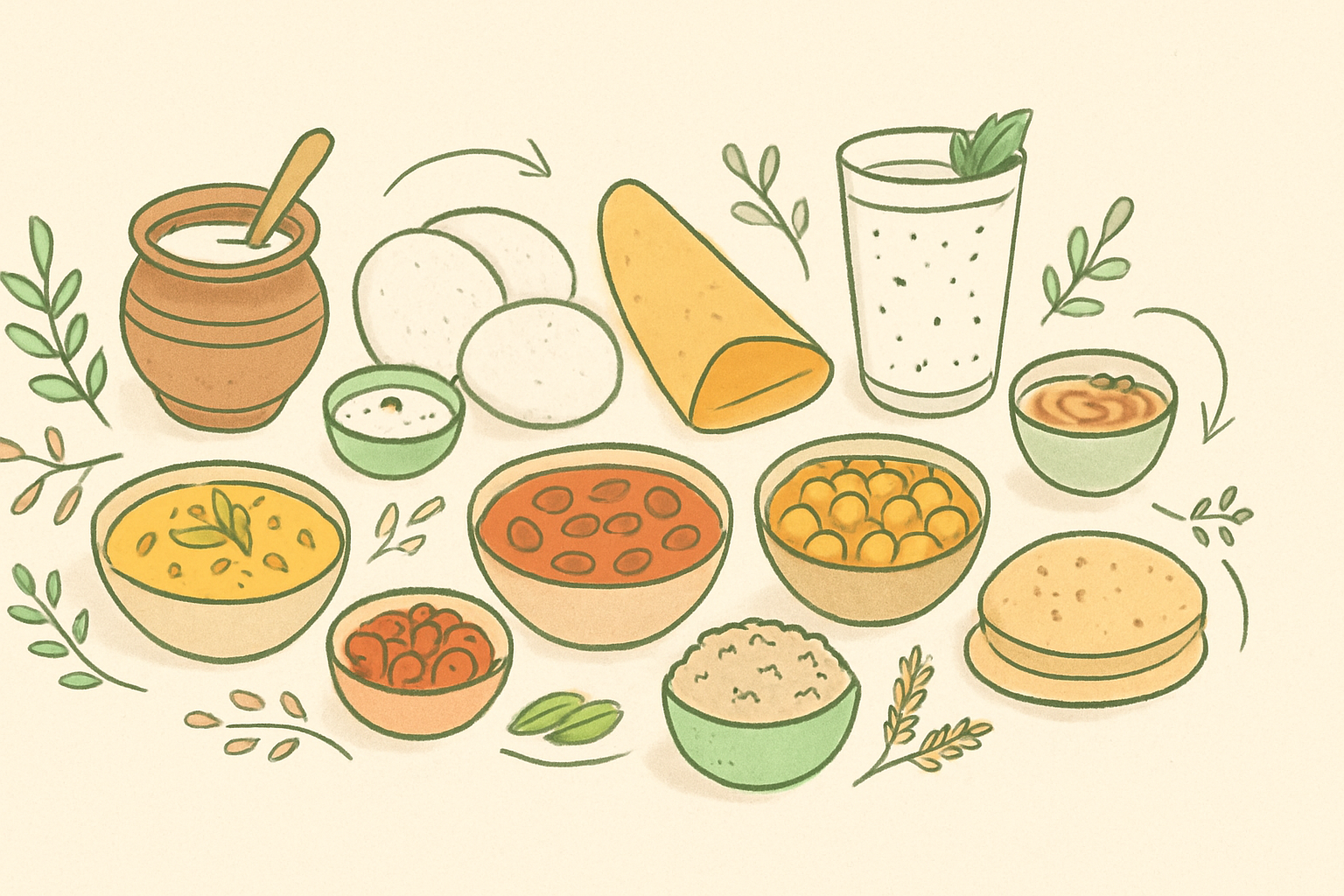
Indian food is one of the most gut-friendly cuisines in the world. Our ancestors knew nothing about microbiomes or probiotics — but they built an entire food culture around fermentation, fiber, and food combinations that are still part of everyday Indian cooking.
The problem is that modern Indian diets have drifted. More maida, less dal. More packaged snacks, less sabji. More white rice, less fermented foods. Your gut bacteria notice.
Here's how to eat for a healthy gut — using foods that are already part of Indian cooking.
What Your Gut Actually Needs
Your gut is home to roughly 100 trillion bacteria. Most are helpful — they help digest your food and make some vitamins. Some are harmful. The balance between good and bad bacteria is what determines whether your gut is healthy.
Good bacteria thrive on three things:
1. Probiotics — live beneficial bacteria (found in fermented foods)
2. Prebiotics — fiber that feeds those bacteria (found in plants)
3. Diversity — variety of foods keeps different bacterial strains alive
Indian cuisine naturally provides all three. You just have to eat the right things.
Fermented Indian Foods (Probiotics)
These are the heavy hitters — traditional Indian foods that contain live beneficial bacteria.
Curd and Dahi
The king of Indian probiotics. One bowl of homemade curd contains billions of lactobacillus bacteria. These bacteria survive the stomach acid and colonize your intestines.
Why it works: Curd contains Lactobacillus acidophilus and Bifidobacterium — two of the most well-studied probiotic strains.
How to eat it: 1 bowl (200g) daily. Plain curd is best. Avoid sweetened flavoured yogurts — they often have more sugar than probiotics.
Best combinations: Add to raita with lunch, have as buttermilk with meals, or eat plain with a bit of black salt.
Buttermilk (Chaas)
Lighter than curd but just as effective. Traditional chaas with jeera, black salt, and mint is a refreshing mealtime drink.
Why it works: Same bacteria as curd, but in a more diluted form that's easier to digest during meals. The jeera and mint add flavour.
How to eat it: 1 glass with lunch or in the afternoon, especially in summer.
Idli and Dosa
The batter for idli and dosa is naturally fermented overnight. During fermentation, lactic acid bacteria multiply and pre-digest the rice and dal.
Why it works: South Indian fermented foods are among the best studied for their probiotic content. The fermentation also reduces anti-nutrients like phytic acid, which normally block mineral absorption.
How to eat it: Idli is better than dosa for gut health — less oil. Pair with sambar (fiber) and coconut chutney (healthy fats).
Pickles (Achar)
Traditional oil-based pickles — not the vinegar-based Western kind — are fermented. Homemade mango, lemon, or mixed vegetable pickles contain beneficial bacteria.
Why it works: The brine-based fermentation creates an environment where good bacteria flourish. Spices like mustard, fenugreek, and turmeric add flavour.
How to eat it: A small spoon (1 teaspoon) with meals. Don't overdo it — traditional pickles are high in oil and salt. The point is the bacteria, not the quantity.
Fermented Rice (Pazhaya Sadam, Panta Bhat)
An old South Indian and Bengali tradition — leftover rice soaked in water overnight. In the morning, it's naturally fermented and becomes a probiotic powerhouse. Eat with a bit of curd, onion, and salt.
Why it works: Research has found that fermented rice water contains beneficial bacteria and increases iron, potassium, and B-vitamin bioavailability by 6-10 times.
Kanji
A traditional North Indian winter fermented drink made from black carrots, mustard seeds, and salt. Tangy and probiotic-rich.
Why it works: Carrot kanji contains beta-carotene, probiotics, and other natural plant compounds.
High-Fiber Indian Foods (Prebiotics)
These feed your good bacteria. Without prebiotics, even the best probiotics starve.
Dal and Lentils
Indian cuisine's secret weapon for gut health. Every bowl of dal is a prebiotic feast.
| Dal | Fiber per Bowl | Gut Benefit |
|---|---|---|
| Rajma | 7g | Highest fiber, excellent for bowel movement |
| Chole (chickpeas) | 6g | Contains resistant starch, feeds diverse bacteria |
| Chana dal | 5g | Rich in fibre, feeds gut bacteria |
| Moong dal | 4g | Easy to digest, good for sensitive stomachs |
| Masoor dal | 3g | High in folate |
| Urad dal | 4g | Traditional choice, pairs well with rice |
The variety trick: Eating the same dal every day is good, but rotating between different types is better. Each dal has slightly different fiber and feeds different bacterial strains. Aim for 3-4 different dals per week.
Whole Grains
White rice and maida feed bad bacteria. Whole grains feed good ones.
Best choices for gut health:
- Bajra (pearl millet) — extremely high fiber, traditional winter food
- Jowar (sorghum) — gluten-free, excellent fiber, pairs well with sabji
- Ragi (finger millet) — high calcium and fiber, great for breakfast
- Oats — contains beta-glucan, a specific fiber that feeds gut bacteria
- Daliya (broken wheat) — easier to digest than whole wheat, still high fiber
- Whole wheat atta — much better than maida. Use for rotis always.
Vegetables — Especially the Fibrous Ones
All vegetables are good, but these are excellent for gut health:
- Okra/bhindi — the slimy texture is literally mucilage, a type of soluble fibre
- Palak/spinach — high fiber, magnesium, and folate
- Methi/fenugreek leaves — contains galactomannan, a specific fiber that feeds gut bacteria
- Cauliflower/gobhi — cruciferous, a good source of fibre
- Sarson ka saag — winter favourite, high in fibre
- Beans/sem — high fiber, protein, and resistant starch
Fruits That Help
Guava — 5g fiber per fruit, the highest of any common Indian fruit. Your gut loves it.
Banana — contains pectin (soluble fiber) and resistant starch, especially when slightly green.
Apple — 2.5g fiber plus polyphenols that specifically feed beneficial gut bacteria.
Papaya — contains papain, a natural digestive enzyme.
Pomegranate (anar) — a source of polyphenols.
Spices That Help Your Gut
Indian spices aren't just for flavor — many have a long place in everyday home cooking.
Turmeric (haldi) — a staple of Indian cooking. Haldi doodh before bed is a traditional favourite.
Ginger (adrak) — a traditional favourite in chai and curries.
Cumin (jeera) — a traditional digestive spice. Cumin water in the morning is a familiar home habit.
Fenugreek (methi) — seeds soaked overnight are a traditional kitchen staple.
Ajwain (carom seeds) — traditionally chewed after meals.
Hing (asafoetida) — traditionally added to dal. A small pinch goes a long way.
Black pepper (kali mirch) — piperine enhances turmeric's absorption. Always pair the two.
A Day of Gut-Healthy Indian Eating
Here's what your day could look like if you built it around gut health:
Early morning: Glass of warm water with 1 tsp methi seeds soaked overnight
Breakfast: 2 idlis + coconut chutney + sambar → Fermented food + fiber + probiotics
Mid-morning snack: 1 banana (slightly green) or 1 guava → Prebiotic fiber
Lunch: Bajra roti + dal (rotate types through the week) + sabji + curd raita + salad → Fiber + probiotics + variety
Afternoon drink: 1 glass buttermilk with jeera and mint → Probiotics + cooling
Evening snack: Handful of roasted chana or 5-6 almonds → Fiber + healthy fats
Dinner: 1 roti + paneer sabji (or egg curry) + light salad → Protein + light, easy to digest
Before bed: Warm haldi doodh (turmeric milk) with a pinch of black pepper → A warm, comforting end to the day
What's Hurting Your Gut
Even with all the good foods above, certain habits undo the benefits:
Maida and refined grains — are low in fibre. White bread, naan, maggi, and most biscuits fall in this category.
Excess sugar — sweet snacks and drinks add up quickly, so keep them occasional.
Too many fried snacks — samosas, pakoras, and namak para are okay occasionally but shouldn't be daily snacks.
Skipping meals — regular meal times make it easier to eat a balanced day.
Eating late at night — a heavy meal at 10 PM can leave you feeling uncomfortable at bedtime.
Antibiotics without probiotics — antibiotics kill both good and bad bacteria. If you are prescribed antibiotics, follow your doctor's advice.
Not drinking enough water — fiber needs water to work. 2-3 liters a day is the minimum for most adults.
Track How You Feel
Everyone's meals and routines are different. Keep a simple note of what you eat and how you feel, and share it with your doctor or nutritionist if you have questions.
You don't need to change everything overnight. Start with one or two additions — maybe a bowl of curd daily and switching your rotis to bajra or whole wheat. Your gut will thank you.
Track What You Eat — Your Gut Will Tell You What Works
Every gut is different. What works for your friend might not work for you. The best way to understand your own gut is to track what you eat and how you feel.
Shellel tracks fiber, calories, and protein for every Indian food you log, so you can see how much fibre and variety are on your plate.
If you're curious about the fibre and variety in your meals, start tracking and see what you actually eat.
Quick answers
Asked and answered
What is the best Indian food for gut health?
Homemade curd, idli/dosa, and dal are the top three. Curd provides probiotics, idli and dosa are fermented foods with beneficial bacteria, and dal provides the fiber your gut bacteria need to thrive.
How much curd should I eat per day for gut health?
One bowl (200g) of homemade curd daily is a common portion. More is fine, but the quality and freshness matter more than quantity. Homemade curd has more diverse bacteria than store-bought.
How much fibre does chole have?
Chole is high in fiber (6g per bowl) and contains resistant starch, which feeds a specific type of beneficial gut bacteria called Bifidobacterium.
Are Indian spices good in everyday cooking?
Cumin, ginger, turmeric, fenugreek, ajwain, and hing are all traditional spices in Indian kitchens, used in dals, curries, and after-meal habits.
Can I eat Maggi if I care about gut health?
Occasionally is okay. As a regular meal, it's not great — it's made from refined flour (maida), has very little fiber, and contains additives. Try to limit it to once every 2-3 weeks and pair with some vegetables or a side of dal. --- Nutrition and gut health information sourced from ICMR-NIN Indian Food Composition Tables, WHO dietary guidelines, and the Shellel Food Database. This article is for informational purposes and does not replace medical advice.