Managing diabetes doesn't mean giving up Indian food. It means understanding which foods raise your blood sugar fast and which ones keep it steady. Most of your favourite meals can stay — with small, smart changes.
This guide is based on ICMR dietary guidelines for Indians with Type 2 diabetes, pre-diabetes, and PCOS (which shares similar blood sugar challenges).
The 3 Rules of Diabetic-Friendly Indian Eating
Before we get into specific foods, here's the framework:
1. Fiber slows down sugar absorption. Every meal should have a fiber source — dal, sabji, salad, whole grain. Fiber means your blood sugar rises slowly instead of spiking.
2. Protein keeps you full and stable. Protein doesn't spike blood sugar the way carbs do. Adding paneer, curd, eggs, or chicken to every meal helps flatten the curve.
3. The order you eat matters. Eat your sabji and dal first, roti or rice last. This simple trick reduces blood sugar spikes by up to 30% — proven by research.
Foods That Help Control Blood Sugar
Dal and Lentils — Your Best Friend
Dal is the single best food for diabetics in an Indian kitchen. It's high in protein, high in fiber, and has a low glycemic index.
| Dal | Protein | Fiber | GI Rating |
|---|---|---|---|
| Chana dal | 9g/bowl | 5g | Low |
| Moong dal | 8g/bowl | 4g | Low |
| Masoor dal | 7g/bowl | 3g | Low-Medium |
| Rajma | 8g/bowl | 7g | Low |
| Mixed dal | 8g/bowl | 4g | Low |
Tip: Chana dal has the lowest glycemic index of all dals. If you can eat it regularly, your blood sugar will thank you.
Vegetables — Load Up
Most vegetables are excellent for diabetics. They're low calorie, high fiber, and don't spike blood sugar.
Best picks:
- Bhindi/okra — has compounds that actually help lower blood sugar
- Karela/bitter gourd — the most studied vegetable for diabetes. Bitter, but effective.
- Methi/fenugreek leaves — fenugreek seeds and leaves both help with insulin sensitivity
- Palak/spinach — very low carb, rich in minerals
- Beans/sem — high fiber, keeps you full
- Gobhi/cauliflower — low carb alternative to potato in sabji
- Sarson ka saag — seasonal, fiber-rich, and pairs well with a small amount of makki ki roti
Watch out for: Potato, arbi (colocasia), and sweet potato in large quantities. They're not banned — just keep portions smaller and always pair with dal or curd.
Curd and Buttermilk — The Secret Weapon
Curd does something special for diabetics: the probiotics and protein help slow down carbohydrate digestion. Having raita or plain curd with every meal is one of the easiest changes you can make.
Buttermilk (chaas) with lunch is even better — low calorie, probiotic-rich, and helps digestion. It's a traditional Indian habit that happens to be medically smart.
Whole Grains Over Refined
This is where most Indian diabetic diets go wrong. White rice raises blood sugar almost as fast as sugar itself.
| Grain | Glycemic Index | Better Alternative |
|---|---|---|
| White rice | High (73) | Brown rice (50) or daliya (45) |
| Maida (naan, bread) | Very High (85) | Whole wheat roti (55) |
| Suji/rava | High (70) | Oats (55) or bajra (50) |
| White bread | Very High (75) | Multigrain roti or jowar roti |
The roti vs rice question: Whole wheat roti is better than white rice for blood sugar. But if you love rice, eat a smaller portion with a large serving of dal and sabji. The fiber from dal and vegetables slows down the rice's sugar impact.
Best grains for diabetics: Bajra (pearl millet), jowar (sorghum), ragi (finger millet), and oats. These are traditional Indian grains that fell out of fashion but are coming back — and they're significantly better for blood sugar than wheat or rice.
Foods to Limit (Not Ban)
You don't have to give up anything completely. But these foods need portion control:
Sugar and sweets: Your daily sugar limit is 20g total (including sugar in fruit and milk). One gulab jamun has about 15g sugar. One mithai piece can use up your entire day's limit. Save sweets for special occasions and keep portions tiny.
Fruit juice: Even fresh juice spikes blood sugar because the fiber is removed. Eat the whole fruit instead — the fiber slows absorption. An orange is fine; orange juice is not.
White rice in large quantities: A small katori (100g cooked) with plenty of dal is okay. A plate piled with rice and a little dal on the side is not.
Fried snacks: Samosa, pakora, and namak para are high in refined carbs and oil. The combination spikes blood sugar and adds calories fast. Limit to once a week, not daily.
Chai with sugar: Two cups of chai with 2 teaspoons each = 16g sugar. That's almost your entire daily limit. Switch to one teaspoon, then try without. Your taste adjusts in about 2 weeks.
A Realistic Diabetic Indian Meal Plan
Here's what a day looks like — not a crash diet, just smart choices:
Early morning (6-7 AM): Methi seeds soaked overnight (1 tsp in warm water) — helps with insulin sensitivity
Breakfast (8-9 AM): 2 moong dal cheela + mint chutney + 1 cup chai (no sugar) → ~220 cal, 14g protein, 4g fiber, low sugar
Mid-morning (11 AM): A handful of roasted chana or 5-6 almonds → ~100 cal, keeps hunger steady
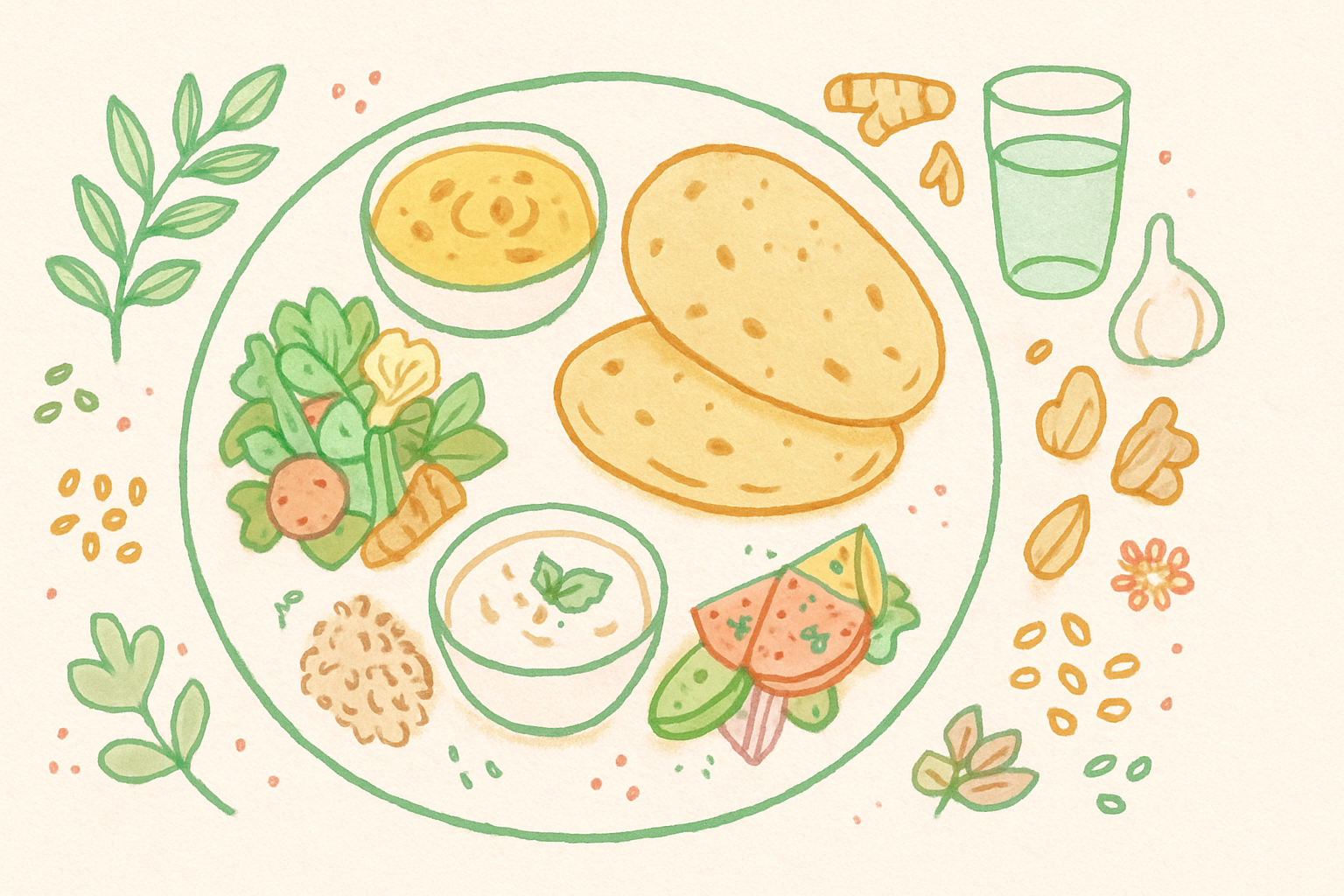
Lunch (1 PM): 2 roti (whole wheat or bajra) + dal (1 big bowl) + sabji + raita + salad → ~450 cal, 18g protein, 10g fiber
Eat in this order: Salad first → sabji → dal → roti last. This alone reduces your post-meal spike.
Evening snack (4-5 PM): 1 cup buttermilk + 1 fruit (apple or guava — avoid banana and mango in excess) → ~120 cal, fiber from fruit, probiotics from buttermilk
Dinner (7-8 PM): 1 roti + paneer sabji or egg curry + salad → ~350 cal, 20g protein
Before bed: 1 glass warm milk (no sugar) or a small bowl of curd
Daily totals: ~1,300-1,500 cal, 60-70g protein, 25-30g fiber, under 20g sugar
The Gut Health Connection to Diabetes
Here's something most people don't know: your gut bacteria directly affect your blood sugar control. Research shows that diabetics have less diverse gut bacteria than non-diabetics.
What helps your gut:
- Fermented foods daily — curd, buttermilk, idli, dosa batter, pickle (in small amounts)
- Different types of dal — rotating between toor, moong, chana, and masoor feeds different gut bacteria
- Fiber variety — sabji, dal, whole grains, fruits. Each type of fiber feeds different beneficial bacteria
- Consistent meal timing — eating at roughly the same times helps your gut bacteria maintain their own circadian rhythm, which supports blood sugar regulation
What hurts your gut:
- Excess sugar feeds harmful bacteria
- Skipping meals disrupts gut rhythms
- Too many antibiotics (talk to your doctor before stopping any medication)
Mistakes Diabetics Make With Indian Food
Eating fruit after meals. Fruit after a heavy meal adds sugar on top of carbs. Eat fruit as a separate snack, 2-3 hours after meals.
Thinking brown rice is free food. Brown rice is better than white rice, but it still has carbs. Keep portions controlled — a small bowl, not a plateful.
Avoiding all fat. Good fats (nuts, seeds, ghee in small amounts) actually help slow sugar absorption. Don't go zero-fat — go smart-fat.
Only checking fasting sugar. Post-meal sugar (2 hours after eating) tells you more about how your diet affects you. Track both.
Eating dinner too late. Eating heavy food after 9 PM disrupts your gut's overnight repair cycle and keeps blood sugar elevated while you sleep. Try to finish dinner by 8 PM.
How to Track Your Diabetic Diet
Knowing your daily sugar intake is critical when you have diabetes. Most people have no idea how much sugar they're eating — it hides in chai, fruit, curd, and sauces.
Shellel tracks sugar alongside calories, protein, and fiber for Indian food specifically. It knows that one gulab jamun has 15g sugar and that your dal has 148 calories. The app also sets a personalized sugar limit (20g for diabetics) and alerts you when you're getting close.
If you've been managing diabetes by guesswork, tracking even for one week will show you exactly where the sugar is coming from — and it's usually not where you think.
Frequently Asked Questions
Can diabetics eat rice?
Yes, but in controlled portions. A small bowl (100g cooked) with plenty of dal and sabji is fine. Opt for brown rice, hand-pounded rice, or millets when possible. Always eat rice with protein and fiber to slow the sugar spike.
Is roti better than rice for diabetes?
Whole wheat roti has a lower glycemic index than white rice (55 vs 73), so it causes a slower blood sugar rise. Bajra and jowar roti are even better. But portion still matters — 2-3 rotis max per meal.
Can diabetics eat fruits?
Yes — but choose low-GI fruits like apple, guava, papaya, and berries. Avoid fruit juice entirely. Eat fruit as a snack between meals, not right after a heavy meal. Limit mango, banana, and grapes to small portions.
How many times should a diabetic eat in a day?
5-6 small meals work better than 3 large ones. This keeps blood sugar stable throughout the day. The meal plan above shows how to space meals every 2-3 hours.
What is the best Indian snack for diabetics?
Roasted chana (chickpeas), a handful of nuts (almonds, walnuts), sprouts salad, or buttermilk with a small fruit. All of these are high in protein or fiber and won't spike blood sugar.
Nutrition data sourced from ICMR-NIN Indian Food Composition Tables and the Shellel Food Database. This article is for informational purposes only and does not replace medical advice. Consult your doctor for personalized diabetes management.